
Alarm Raised in Aizpute over the Disappearance of Historic Buildings
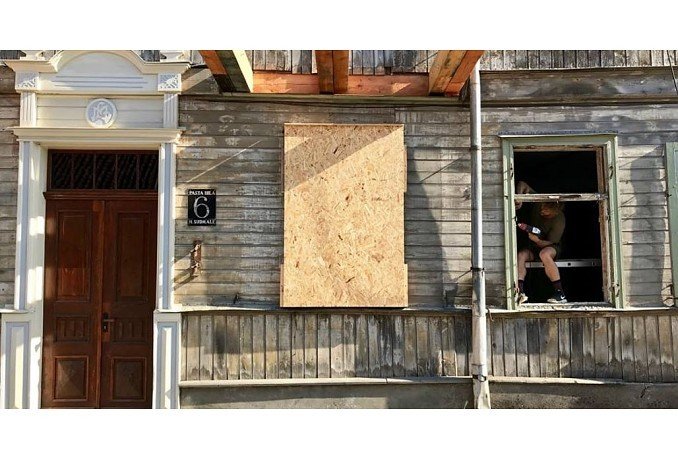
Without historic buildings and a successful tourism infrastructure offering, smaller inhabited places are exposed to decline or even complete destruction, as the experience of old Europe demonstrates. These and other issues were raised at a meeting between owners of buildings in Aizpute’s old town and building archaeologist Juris Zviedrāns. For the first time, a practical lecture was held in the small Kurzeme town of Aizpute for building owners, encouraging them to pay closer attention to the town’s heritage and to consider how to make it appealing to tourists from around the world.
In an era when people are moving to large cities, small settlements in Germany, for example—where no one lives anymore—are sometimes razed to the ground, says lecturer and one of the restorers of Tāšu Manor Juris Zviedrāns, citing one such example. But in Finland, Germany and elsewhere, there are examples of small settlements with ancient historic buildings being preserved, with their tourism offerings successfully finding a place on the global tourism map. Aizpute has the status of a small town, but it was an important centre in its time, says Juris Zviedrāns:
„There was what was known as the Piltene District, which emerged after the collapse of Livonia. This district existed longer than the Duchy of Courland. Aizpute was subordinate not to the Duke of Courland, but to the King of Poland. Aizpute has many cultural landmarks—the medieval castle, the recently opened Kurzeme Cathedral Church, old cemeteries and so on. Apart from these major landmarks, concentrated in a small area, there is also a great deal of fine wooden architecture.”
A kind of signal and warning bell that the time has come to act was the meeting organised by the Aizpute Tourist Information Centre with owners of historic buildings.
The fact that so many interested people gathered shows that the question of what to do with old towns is becoming increasingly urgent; it is also an incentive for the municipality to take action.
“The initiative came from local residents who manage historic buildings. The question of what should and should not be done has arisen repeatedly. We see that from time to time a building disappears, while additions and incongruous elements—plastic windows and other objects—are introduced,” says Signe Pucena, head of tourism in Aizpute Municipality.
We love travelling and admiring beautiful old towns elsewhere in the world, having tea or coffee there, but at home this potential has been only partially utilised. These contrasts have prompted much more serious reflection on the settlement itself—Aizpute—and its potential.
“We look at our town and know that it began to develop in the thirteenth century, while most of our wooden buildings date from the eighteenth century. This raises the question: what will we leave to future generations? By readily embracing new materials and new possibilities, are we not spoiling it?” asks Pucena.
Contrary to the trend of moving to cities, many determined people are doing the opposite—returning to the countryside or to their native small towns. This is also the story of Mārtiņš Sprūds, who recently inherited a property in Aizpute. At present, he has more questions than answers about what to do with the historic building so as not to damage it:
“We have been living in Aizpute with our family for six months and working in Liepāja. The property was built in 1905 and later became a rental building. Until now, very little attention has been paid to the condition of the building; it has been poorly maintained, and the passage of time has damaged it. I am ready to restore it so that it does not lose its character and distinctive features.”
One example of attention being paid to the preservation of Aizpute’s historic heritage is the artists’ residency “Serde”, located in Aizpute. The building managed by the “Linmeijers” association is also currently undergoing transformation. Vilis Brūveris can now share his experience of where to begin and how to attract funding from the State Culture Capital Foundation. With the support of a local restorer, the entrance door, balconies characteristic of Aizpute’s wooden architecture and several windows have already been restored. This is one example that encourages the revival of the small town’s former glory. Vilis Brūveris emphasises that the whole community benefits when a building’s façade is put in order:
“If it is private property, then it is also the owner’s responsibility. As we heard in Juris Zviedrāns’s lecture,
A person can accomplish a great deal with their own hands; that is the first and greatest resource. Intellectual and mental resources are also important.
Latvia has nationwide programmes available, as well as programmes in individual municipalities, for putting various small practical matters in order, but this can happen only when the owner has a vision of how they plan to develop the property.”
A support programme for restoring historic buildings has not yet been established in Aizpute Municipality. In Kurzeme, Kuldīga has so far invested the greatest resources and accumulated the most experience in preserving its old town; as a result, tourist attractions characteristic of old towns in Western Europe have emerged, such as cafés and apartments located precisely in the city centre, which is attractive because of its historic character. In recent years, Liepāja has also implemented a special support programme for owners of buildings in its old town.