
Open Letter Concerning the Monument to Andrejs Upīts
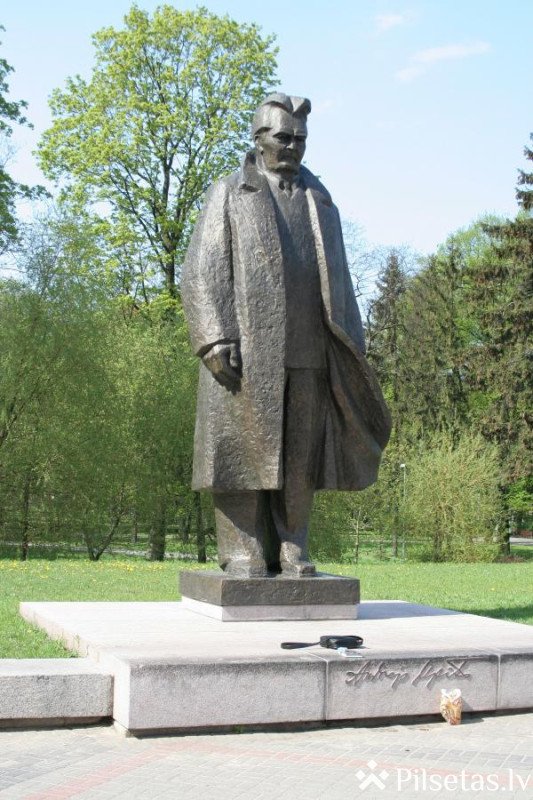
There has already been much debate about dismantling the monument to Andrejs Upīts, and several cultural figures have signed an open letter to Riga City Council Chair Mārtiņš Staķis and the members of Riga City Council.
The proposal initiated by the Centre for Public Memory and supported by the Riga Monument Council to dismantle the sculptures of several literary figures (including Latvian writer Andrejs Upīts (1877–1970)) in Riga’s urban environment involves several problems and undeniable contradictions.
In the debates, the sculptural objects proposed for dismantling were called “icons of the empire”. One must immediately ask: should Andrejs Upīts be separated from the Russian poet Alexander Pushkin (1799–1837) or the Latvian writer Anna Sakse (1905–1981)? Pushkin was an important author for several generations of Latvian classics, including Upīts, who studied Pushkin’s poetry independently in his early youth, while Sakse, although primarily representing the prose of the totalitarian era and the period of Soviet occupation, also created a collection of short prose that is valuable and enduring from an artistic standpoint, “Tales of Flowers”.
It should be emphasised that Andrejs Upīts’s contribution to Latvia’s cultural history is considerably broader. The writer began his literary career in the early years of the 20th century, and by around 1910–1914 had become a relatively prominent author in Latvian literature. During the years of the Republic of Latvia, Upīts was not only the author of many original works, but also created a history of Latvian literature (1921), and, in collaboration with the literary scholar Rūdolfs Egle, a history of world literature (1930–1934); he was also the author of several entries in the Latvian Encyclopaedic Dictionary. For his achievements in dramaturgy, the writer received the Cultural Foundation Award in 1927. By the beginning of the Soviet occupation in 1940, Upīts had written a large proportion of his most important works, which continue to be of great significance in Latvian culture. Overall, Upīts should be regarded as one of the most influential 20th-century authors in the history of Latvian literature.
Objectively, Andrejs Upīts may be reproached for travelling to Moscow in July 1940 together with the other members of the People’s Saeima delegation to request Latvia’s admission to the USSR, thereby further strengthening the Soviet occupation regime in the country. It is likewise objectively possible to reproach him for everything Upīts did in journalism and literary history from the beginning of the 1940s until his death in 1970—particularly his attacks on Latvians in exile, which may essentially be regarded as moral and literary violence. Nevertheless, it should be added that state archives contain no documentary evidence that Andrejs Upīts was directly responsible for political repressions—either in 1919, when the writer held political office for just under five months, or after 1940. Even when serving in 1919 as head of the Art Department of the Commissariat of Education of Soviet Latvia, Upīts’s policy was directed towards culture rather than other issues concerning the repression of his contemporaries, and this fact is often questioned in the public sphere today without any documentary basis.
It should be remembered that Upīts was always a strong defender of the Latvian language—the writer’s literary works attest to his broad and multifaceted vocabulary, which also possesses cultural and historical value. Twice during Upīts’s lifetime, the writer had the opportunity to remain and work and live in Soviet Russia—both in 1919 and after 1940—but both times he decided to return to his homeland and continue working specifically with Latvian literature. Even literary works created during the Soviet occupation, such as the novel “The Green Land”, document the cultural history of his native area (Skrīveri Parish)—the recording, description and reflection of the writer’s native region at the turn of the 19th and 20th centuries. At the same time, it vividly reveals and typifies social developments in the territory of Latvia at that time.
Today, the proposal is often voiced to view a literary heritage separately from an author’s public image. And yet, is it possible to separate a writer from a public figure or political personality? In that case—which part of the monument should we dismantle, and which should we leave?
Several of Andrejs Upīts’s literary works are still included in school curricula. The story “The Boys from Mossy Village” is studied in Latvian language and literature lessons in Grades 6–7; the novel “Gold” is offered to upper-secondary classes as a vivid example of naturalist literature, while students at humanities-oriented educational institutions also read the writer’s short stories and historical tragedies from the 1920s and 1930s. After the restoration of Latvia’s independence, Upīts’s work has also periodically been revisited in various new interpretations at Latvia’s largest theatres; the most recent of these were at the Latvian National Theatre (1996, 2013, 2015) and the Daugavpils Theatre (2021).
Splitting the writer’s memorial would naturally imply that his literary heritage or name should be avoided or regarded with shame.
However, such action raises another question—is this not the censorship of art so often mentioned in recent years? There is currently no constructive polemic: objective and scientifically grounded historical research has been replaced by political interpretations. One may reject evidence from the Soviet period, but in that case this means engaging in the same practice of rewriting history that was employed—and for which the writer is most reproached in the context of his biography—under the conditions of occupation. A black-and-white division of the world existed within the canon of socialist realism, in which antagonism could initially be between the “bad” and the “good”; but once everything “bad” had been eradicated, conflict could arise only between the “good” and the “even better”. Have we reached such a model of the world again in the 21st century? What is most important for our nation: to acknowledge the writer’s positive contribution and artistic power or, conversely, by simplifying matters, to emphasise the negative and condemnable aspects—those ideologically unacceptable to us?
The author of the sculpture of Andrejs Upīts was Alberts Terpilovskis (1922–2002), former head of the Sculpture Department of the Art Academy of Latvia (1971–1998). It is important to add that under his leadership the traditions and monumentality of Latvian plastic art, as well as its diversity and understanding of materials, were developed in all genres and forms of sculptural expression. Alberts Terpilovskis’s diploma students, like the students of Konstantīns Rončevskis, Kārlis Zemdega and Kārlis Zāle in their time, became strong and interesting authors whose works can be seen throughout Latvia. The bearing of the professor, teacher and public figure arose from the sculptor’s own artistic interests. It should be remembered that, already during the educational process, Alberts Terpilovskis encouraged his students to create portraits of Latvian cultural figures of the 20th century, thereby preserving evidence of our history and the memory of valuable writers, artists and actors. In this way, approximately one hundred works were created and placed free of charge in schools and cultural centres throughout the country. There is no comparable achievement in Latvia’s cultural history.
Alberts Terpilovskis’s sensitive and deeply perceptive portraits of figures from the cultural environment will remain in Latvian art for all time: Valdis Dišlers (1965), Gunārs Kirke (1973), Raimonds Pauls (1978), Emīls Melderis (1983), Pēteris Pētersons (1985), Jānis Streičs (1991), Jānis Peters, Ēvalds Valters and many others.
The monumental work—the monument to Andrejs Upīts (1982, created in collaboration with architect Gunārs Asaris (1934–2023))—also belongs to this artistic line in the sculptor’s treatment of content and form. The work clearly conveys the writer’s bearing, his rich contribution to Latvian literature, his contradictory character and his portrait likeness. The ensemble itself must be viewed as a whole, together with the adjacent building, its placement and the lawn (as a reference to the culturally and historically significant novel “The Green Land”); with its generalised, geometrical forms and rhythm, it is a unique artistic testimony to its era. It should be added that few ensembles of such full artistic integrity have survived in Latvia, and they constitute an important link in the continuity of Latvian sculpture.
The contradictions of the era can also be read in the sculptural image (static quality combined with dynamism). Alberts Terpilovskis’s sculpture of Andrejs Upīts embodies the dualism hidden within the writer: on the one hand, it depicts the typical features of a personality of the socialist era; on the other, it conveys a remarkably precise image of Upīts as a ponderous personality and tenacious literary critic, and for precisely this reason the sculptural object should be regarded as a unique testimony to its era.
It should be added that discussions and controversial monuments encourage critical thinking, which modern society and the learning process through democratic understanding require. Testimonies in the urban environment not only remind us of this lesson, but also promote society’s education and responsibility for our history and culture as a whole.
We, the undersigned, call on Riga City Council not to support the proposal initiated by the Centre for Public Memory and the Riga Monument Council to dismantle the monument to Latvian writer Andrejs Upīts:
1. Arnis Koroševskis, senior specialist at the A. Upīts Memorial Museum, literary scholar;
2. Ilze Puķe, director of the A. Upīts Memorial Museum;
3. Rita Meinerte, director of the Association of Memorial Museums;
4. Inese Kaire, former director of the A. Upīts Memorial Museum;
5. Jānis Garjāns, former specialist at the A. Upīts Memorial Museum;
6. Arno Jundze, chair of the Union of Latvian Writers, writer and publicist;
7. Ingrīda Burāne, art historian, head of the Information Centre of the Art Academy of Latvia;
8. Gundars Āboliņš, actor;
9. Karina Pētersone, director of the Support Society of the National Library of Latvia;
10. Mārtiņš Mintaurs, historian;
11. Kristīne Želve, writer and publicist;
12. Juris Pūce, politician;
13. Māra Svīre, writer;
14. Ainārs Dimants, researcher;
15. Jānis Elsbergs, writer;
16. Inese Ozoliņa, senior specialist at the A. Upīts Memorial House in Skrīveri;
17. Laura Tabuna, educational programme curator at the A. Upīts Memorial Museum;
18. Elīna Anna Oļehnoviča, collection keeper at the A. Upīts Memorial Museum;
19. Rūta Kārkliņa, director of the Krišjānis Barons Museum;
20. Zanda Rozenberga, director of the Rainis and Aspazija Museum;
21. Viesturs Vecgrāvis, literary historian;
22. Daina Vancāne-Viļuma, Latvian language and literature teacher at Andrejs Upīts Secondary School in Skrīveri;
23. Gundega Blumberga, editor;
24. Ieva Kalniņa, literary scholar;
25. Gaida Jablovska, literary historian and researcher of Rainis and Aspazija;
26. Ieva Ķīse, director of the Ojārs Vācietis Museum;
27. Mārtiņš Bērziņš, senior specialist at the Ojārs Vācietis Museum;
28. Dora Pauzere, collection keeper at the Ojārs Vācietis Museum;
29. Dace Vosa, director of the Jānis Rozentāls and Rūdolfs Blaumanis Museum.
https://memorialiemuzeji.lv/atklata-vestule-par-andreja-upisa-pieminekli/








