“Hands and Threads”
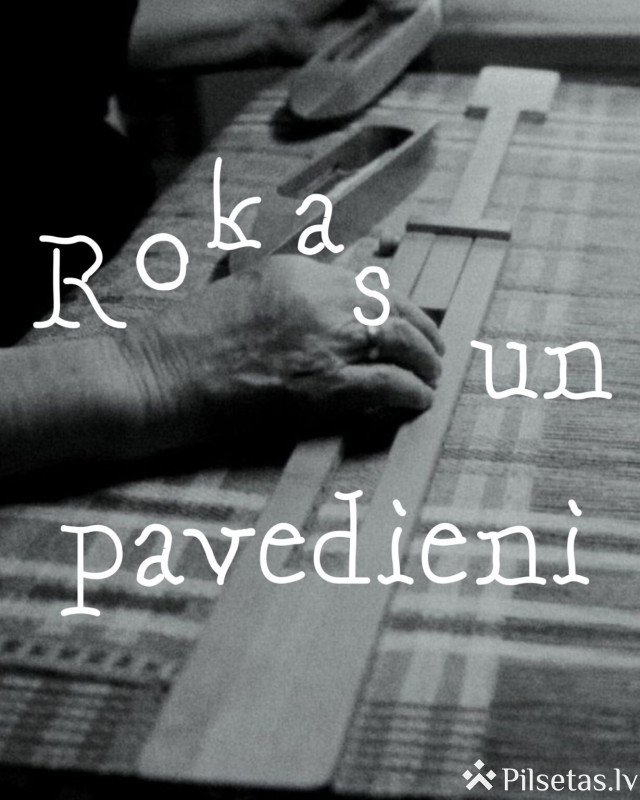
The “Valmiera” Folk Applied Arts (FAA) Studio, which began operating in 1946, is celebrating its 80th anniversary this year. This occasion demonstrates that ancient skills can also be contemporary, relevant and creatively diverse in today’s cultural environment. To mark the anniversary, the exhibition “Hands and Threads” will be on display at Valmiera Museum from 7 March to 22 April. The exhibition will open at Valmiera Museum on 7 March at 2 p.m.
An accompanying programme is also planned for the exhibition “Hands and Threads”: a beginner’s mitten-making workshop on 21 March, a continuation of the mitten-making workshop for participants with prior knowledge on 4 April, and an art workshop with Elīza Māra, “Drell, but Embroidered”, at Valmiera Museum on 17 April from 5 to 8 p.m. (paid event). A creative workshop for young people with Baiba Mince, head of the “Valmiera” Studio, is also planned—an opportunity to create everyday accessories. A communal knitting afternoon will also be organised, providing an opportunity to meet, create together and find inspiration.
The exhibition will be one of the activities in the programme of the Latvian Art of the Year Award, which will be presented in Latvia, in Valmiera, for the first time, establishing a tradition for the country’s highest award in visual art. The exhibition has been created as a poetic and respectful tribute to the weavers whose hands have woven threads into blankets, songs, stories and people through many generations before us. The exhibition’s creators have chosen the thread as the central symbol of time, memory and identity, creating a spatial solution in which everything reaches upwards—works of applied art levitate among white threads, forming both a flying mountain of mittens and an endless spiral of blankets winding through the centuries, allowing the hands of weavers from the past and present to meet in one space and time. Special significance has also been given to the soundscape created by ethnomusicologist and composer Liene Skrebinska—sound becomes the viewer’s companion, leading into a world where the voice transforms into yet another thread to follow.
Baiba Mince, head of the studio, emphasises that the collective is constantly changing. Despite the considerable age range—from 33 to 88—the collective continues to develop as a friendly and close-knit group, united by a shared interest in the ancient craft of weaving. Baiba is pleased that the members choose to work on increasingly technically complex pieces, improve their skills and share their knowledge. “I can be proud when I see the sparkle in their eyes as they learn something new, when a piece turns out well, when the colours in the fabric come together as intended—or, quite the opposite, when the result is a surprise,” Baiba Mince says joyfully.
The exhibition concept was created by the design and communications studio “Ausme”. Its representatives Dārta Apsīte, Beāte Broka and Teiksma Janke explain: “We wanted to create a space in which tradition would become a living, inherited ritual—a never-ending drawing of the warp from one generation to the next. We understand the thread as a metaphor for time, prompting very personal reflection: how many woven shawls lie between me and my great-grandmother? This process enables us to realise much more closely that we are all part of a great continuation.” The exhibition was also developed by scenographic curator Dārta Sakārne, technical producer Zane Meldera, composer Liene Skrebinska, Baiba Mince, head of the “Valmiera” FAA Studio, and the studio’s members; graphic designer Paula Buškevica and video artist Uģis Brālēns also contributed. Technical implementation was provided by SIA “MOOW” and Valmiera Museum. The project manager was Madara Seile, cultural project manager at the Culture Administration of the Valmiera Municipality.
The exhibition is supported by the Valmiera Municipality, Valmiera Culture Centre, Valmiera Museum and AS “Valmieras stikla šķiedra”.
About the “Valmiera” FAA Studio
Throughout its history, the studio’s main activity has been weaving—one of the world’s oldest crafts, which has retained both practical and symbolic significance through the centuries. “Valmiera” takes pride in Vidzeme’s rich weaving traditions and high level of craftsmanship, passed down through generations from hand to hand and loom to loom.
On 29 November 1971, the studio received its official name—the “Valmiera” Folk Applied Arts Studio—affirming its place in Latvia’s craft and cultural heritage.
The studio’s premises have changed over time: from 1946 to 1964, they were located in Vecpuišu Park; in 1964, at Valmiera Culture Centre; around 2001, in Auseklītis House; from 2016 to 2024, at 25C Rūpniecības Street; and since 2024, at 10 Garā Street, where historical experience has found a new space and new vitality.
The studio has been led by outstanding masters: Maija Lezdiņa (1946–1965), Ārija Zvirbule (1965–1974), Ruta Zvirbule (1975–1980), Inta Indriksone (1981–1985), Anita Kuzma (1983–2001), Gaļina Birkava (2001–2013), Elīna Tetere (2014–2018) and, since 2019, Baiba Mince. Each leader has left their mark on the studio’s development, introducing new ideas while preserving traditions.
The number and composition of studio members have changed over time: in the 1960s and 1970s, the studio had around 60 members, while in the second half of the 1980s it had more than 80, representing various fields, including weaving, basketry, woodworking, leatherwork, metalwork, ceramics, jewellery and amber processing. In 1991, the number of members fell to 65, and in 1997 to 46.
The studio has been an important centre for Folk Crafts Masters. In 1960, nine members were awarded the honorary title of Folk Crafts Master; by 1970, the title had been awarded to 35 members. Later, when the Chamber of Crafts began granting journeyman and master status, the state stopped awarding the TDM title, but the studio’s tradition of learning and excellence endured.
The studio has regularly participated in exhibitions and fairs both in Latvia and abroad. In the early 1980s, pennants were woven and embroidered for Song Festival ensembles. For more than 50 years, the studio has participated in the exhibition-fair organised by the Latvian Ethnographic Open-Air Museum, while also regularly representing Latvian applied arts at both national and international levels. The studio’s exhibitions have been held at former branches of Valmiera Museum, concert halls, the choir hall of Valmiera Culture Centre, in Riga, at the “Latvija” Hotel, at the Presidential Palace, in the exhibition hall of the Open-Air Museum and abroad.
In 1982, textile artist Anita Kuzma began leading the studio. There were 75 members, 40% of whom were Folk Crafts Masters. This period was rich in local activities, exhibitions in neighbouring parishes, participation in district events, republican applied arts exhibitions and Song and Dance Festivals, as well as orders for national costumes from various ensembles. Much time was devoted to researching and recreating Latvian national costumes. Materials were studied and copied from the collections of the Latvian Museum of History and the Valmiera Museum of Local History, as it was then known. The ceremonial costumes created by the members themselves were also kept at home for celebrations, as an intergenerational heritage for their grandchildren. The Singing Revolution and the Awakening—everything with a national character was prepared, bought, sold and given as gifts, celebrated and sung about. Everything changed and transformed.
In 1985, the studio took part in the republican Song Festival procession for the first time. That year’s season was packed with events, including exhibitions, among them a blanket exhibition at the Valmiera Glass Fibre Factory. There was also a joint exhibition by three Vidzeme studios—“Saulīte”, “Mazsalaca” and “Valmiera”—at the Valka Museum of Local History.
The year 2002 revealed new trends, demanded by the times and by the country’s economic relations. The studio became a modern, creative collective. The workshop produced dazzling clothing fabrics in the tapestry technique, airy accessories using openwork techniques, finely woven linen fabrics—tablecloths, curtains and decorative towels—thick, silky bath towels, velvety-soft blankets, shawls, rugs, cushions and more. The eternally young, millennia-old flax was combined with wool blends, wool and the latest-generation materials—fancy yarns. With these collections, the studio took part in national and international folk applied arts exhibitions in Slovakia, Belgium, Estonia and elsewhere, as well as international craft fairs in Poland, Estonia, Finland, France, Scotland and Sweden, and seasonal craft markets at home.
Since 2024, the studio’s home has been at 10 Garā Street. This move also marks a new chapter in the studio’s story, in which knowledge accumulated over decades continues to live and develop.
The studio creates ethnographic national costumes, Vidzeme šatier blankets, colourful woollen shawls, elegant linen towels, clothing fabrics and scarves. Alongside traditional works, modern home-textile products are also taking an increasingly prominent place—throws, kitchen towels, table runners, napkins and rugs—demonstrating that folk applied arts fit naturally into contemporary life.
For more than five decades, the studio has participated every year in the exhibition-fair organised by the Latvian Ethnographic Open-Air Museum, traditionally held on the first weekend of June. “Valmiera” is also regularly represented at Song Festival applied arts exhibitions and other national-level exhibitions, where studios from all regions of Latvia meet. Once a year, the studio also organises its own exhibition to show Valmiera residents and city visitors what has been accomplished during the year.
Participation in international and charitable events is also an important part of the studio’s activities. For Advent markets in Germany, the studio’s members knit socks and mittens throughout the year, bringing Latvian craft skills and warmth to Germany as well. For several years now, the studio has donated its works to the NATO Charity Bazaar, as well as knitted socks to the defenders of Ukraine.
The 80 years of the “Valmiera” FAA Studio tell a story of handwork, patience, togetherness and creative strength. “Valmiera” demonstrates that folk applied arts are not a relic of the past, but a living cultural language in which every thread preserves a memory and every work continues into the future.
Information prepared by:
Nora Urbāne,
Cultural Project Manager at the Culture Administration of the Valmiera Municipality