Interactive Route “Be Inspired in Jelgava!”
Published: 20.04.2022
Add Events
The interactive route “Be Inspired in Jelgava!” will introduce travellers to famous people who were born or worked in Jelgava, important sites in the city, and allow them to explore the city through various stories.
New! We invite you to explore the city interactively with the mobile application Tours Across Baltics, which features audio stories and descriptions of the city’s tourist attractions: https://toursacrossbaltics.qrd.by/jelgava
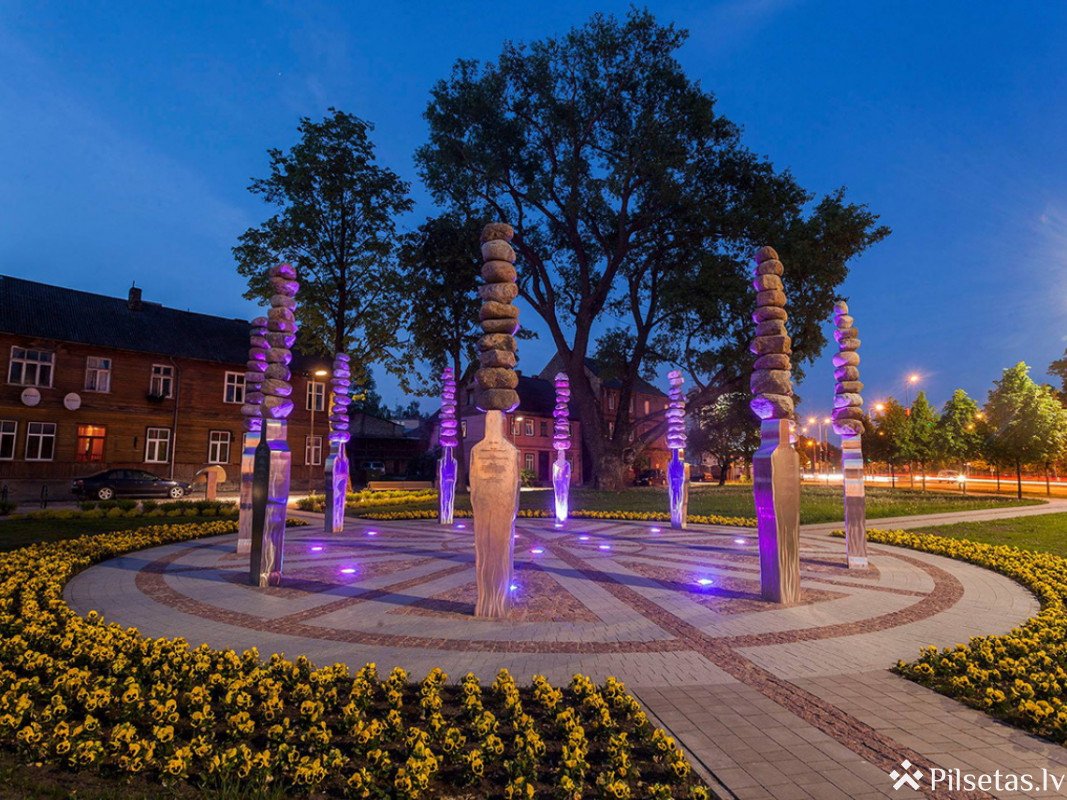
The walk begins at Jelgava Culture House. The city’s first Culture House was located on Philosophers’ Street, later in the Daugava Sports House, while the Jelgava Culture House known today was opened in 1963. Jelgava Culture House has four halls. The largest can accommodate 670 spectators. Various performances and artistic events, as well as rehearsals, take place here. Today, the building is home to 31 amateur arts groups and two professional ensembles. Various exhibitions are regularly held in the Culture House lobbies. A Memorial to the Singer Nora Bumbiere has been installed in the square behind Jelgava Culture House. The sculptor K. Īle combined two of N. Bumbiere’s songs in his work—“A Song about the Last Leaf” and “The Silent Song”. Continuing along K. Barona Street, you will reach St Anne’s Lutheran Church. It is the oldest surviving building in Jelgava. The church houses Janis Rozentāls’s 1910 painting “Christ and the Samaritan Woman”. The next stop is the Old Town Street Quarter. This is the oldest built-up part of the city, with wooden buildings that were not destroyed during the Second World War. Here you can also see the Dobele Gate memorial, installed at the site of the historic city gate. Next to Old Town Street stands the environmental object “Wheel of Time 100”, created by sculptor Kārlis Īle. Ten figures are arranged in a circle, symbolising people important to the formation and development of the Latvian state. The figures are engraved with the most significant events of each decade in the context of Jelgava, while on their reverse side everyone can see their own reflection. Not far from the environmental object stands one of the city’s notable trees—the black poplar, whose trunk circumference is 6.89 metres.
Throughout the ages, people have been guided and inspired by the theme of love. When visiting Love Alley, visitors will have the opportunity to learn how the place got its name and which tradition it is associated with. The next stop is the wooden footbridges in the Svēte floodplain meadows, where you can enjoy peace and take a walk 1.5 metres above the ground. Two information boards have been installed on the footbridge platforms, providing information about the Svēte floodplain meadows, their flora and fauna, and the characteristics of spring floods. The interactive walk then leads to the home of the father of Latvian theatre, or the Ādolfs Alunāns Memorial Museum. When it is not possible to visit the museum in person, anyone can listen to the story in the application and learn more about Ā. Alunāns’s life and contribution to Latvian theatre. Few people know that the father of Latvian theatre is buried in Alunāns Park. The park was created on the site of the former Jāņi Cemetery. The grave and the monument to the father of Latvian theatre, Ādolfs Alunāns, erected in 1913 by sculptor Burkards Dzenis, have survived to the present day. The park also contains a monument to Juris Māters, one of the figures of the Latvian national awakening and founder of the Jelgava Latvian Society.
Next to Alunāns Park stands St John’s Lutheran Church. It is one of Jelgava’s newest churches, built in 1845–1847. The next stop is the buildings on Zemgale Avenue, where some pre-war Jelgava houses have survived, offering an impression of what the city looked like at that time.
The walk ends at Jelgava Student Theatre, founded in 1946 and one of the two oldest student theatres in Latvia. It is the only student theatre with its own theatre building and historic artistic space—the Melpomene Living Room. Jelgava can be regarded as the birthplace of theatre sports from the very beginnings of improvisational theatre in Latvia, thus indirectly continuing Ā. Alunāns’s path as a novice.
Categories:
Culture;