
Japanese Student Gifts Ķemeri’s “Forest House” Unique Wall Murals
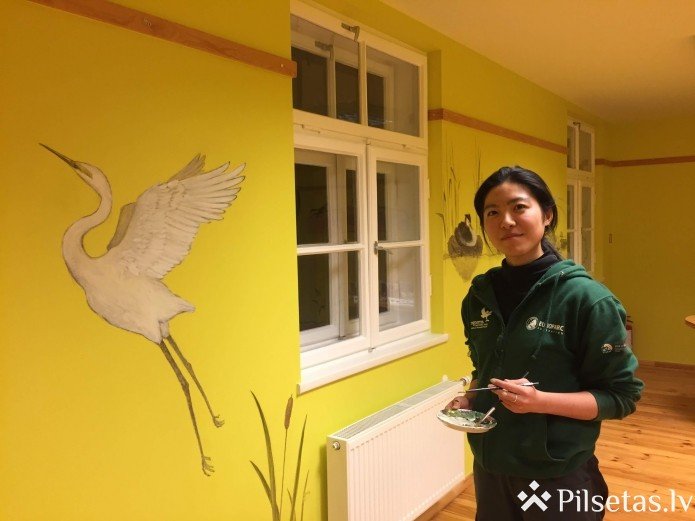
Japanese student Konatsu Hagita, who spent a year on an internship in Latvia, has brought the rooms of the Nature School at the “Forest House” nature education centre of the Nature Conservation Agency in Ķemeri National Park to life with paintings of plants and animals found in the national park.
This is her farewell greeting to every park visitor, encouraging them to appreciate the natural values found here more highly.
The wall murals will delight visitors to the ĶNP information centre as well as participants in the nature school and public events. The murals depict bird species specially protected in Latvia and found in ĶNP, including the great egret, great bittern and great crested grebe; various rare plant species found here, such as the yellow lady’s-slipper and fragrant orchid; as well as animals typical of Latvia’s fauna and living in the ĶNP area—the beaver, fox and squirrel.
K. Hagita stresses that all the murals were inspired by what she herself saw in Latvia: “I have personally observed and memorised everything I have painted here, mostly in the ĶNP area. It was a great honour to leave such lasting ‘traces’ in Ķemeri. I will be truly happy if my paintings bring people a smile, lead to new discoveries in nature or simply give them joy. Latvia’s nature is truly surprising. I want those living in Latvia to recognise and appreciate it.”
K. Hagita first became acquainted with Latvia in 2015, when she came here to teach Japanese to Latvian students. The young woman was so inspired by Latvia’s natural diversity and the people’s love of nature that she decided to return for a year of exchange studies, studying biology at the University of Latvia. To gain a better understanding of Latvia’s nature conservation system, K. Hagita also applied for a volunteer internship in ĶNP.
“On a global level, I am very concerned about nature conservation in Japan. People are losing interest in nature, even though it is very beautiful in Japan and something to be proud of. I was very pleasantly surprised when, during my visit to Latvia in 2015, I saw that most Latvians love nature and have not yet lost their connection with it. Therefore, I decided that this was the right place to look for solutions that could help me change society’s attitude in the future by encouraging people to treat nature more responsibly,” K. Hagita explains.
Over the course of the year, K. Hagita took part with Agency staff in various species-monitoring activities, carried out nature management and conservation work, contributed to the development of sustainable tourism and participated in nature education. The young woman is also a talented photographer. She has left the Agency a substantial photographic archive.
Having spent a year in Latvia and learned about practical nature conservation, K. Hagita formed the impression that nature is preserved in Latvia in highly natural ways. “For example, when we reinforced erosion-threatened dunes on the coast by building woven fences, we obtained the weaving material right there, using willow branches that had grown densely in the area. In my opinion, that is very sustainable. And when we cleared excess grass and shrubs from a grassland fen, we later burned the collected material right there under suitable conditions. By comparison, lighting a campfire outdoors is prohibited in Japan. We even collect grass and put it into bags as ‘combustible waste’. Latvians have an excellent understanding of what nature is and allow it to remain natural. This applies, for example, to preserving deadwood,” K. Hagita says.
She also views positively the fact that nature conservation specialists in Latvia involve local communities in nature management activities. “It is excellent that many activities are publicly accessible. It is so important to explain what is being done for nature and why, and to show how this good work is carried out, thereby maintaining and encouraging interest in nature. Among young people too. They still have the opportunity to experience real nature in Latvia… I wish the same for future generations,” says the young woman.
K. Hagita accumulated so many impressions of nature during the year that she finds it difficult to say what she enjoyed most here. “Everything here was new and amusing to me—picking berries or mushrooms in the forest, swimming in a river, sliding across a frozen lake (yes, no young person in Japan does that!). I truly enjoyed life in Latvia and in Ķemeri National Park,” K. Hagita says.
Each year, in cooperation with various organisations, the Agency hosts up to ten interns and volunteers from Latvia and other countries for short- and long-term placements. For example, it has established a stable partnership with the French college Campus La Salle St. Christophe. Every year, students from the University of Latvia, Vidzeme University of Applied Sciences, Liepāja University and other higher education institutions also acquire practical skills in nature conservation, management, sustainable tourism, nature education and even translation at the Agency, including in Ķemeri National Park.








