Jazz in Watercolour. Water, Pigment and Time.
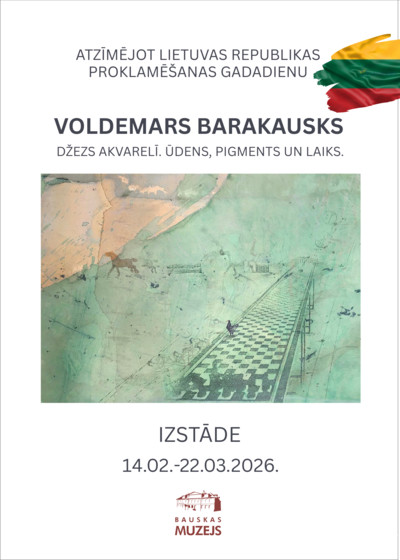
From 14 February to 22 March 2026, Bauska Museum will host an exhibition of watercolours by Lithuanian artist Voldemaras Barakauskas, “Jazz in Watercolour. Water, Pigment and Time.”
The exhibition opening and meeting with the artist will take place on 14 February at 1:00 p.m. At the opening, Airina Litvinskaite, a fourth-grade pupil at Žeimė Primary School, and music teacher Daiva Gaseniene (Lithuania) will give a musical performance.
Admission to the exhibition will be free on the day of its opening.
The opening of the exhibition by Lithuanian artist Voldemaras Barakauskas marks an important date on 16 February—the anniversary of the proclamation of the Republic of Lithuania. The exhibition is an expression of our respect and friendship for our Lithuanian neighbours. The museum also presents it as a symbolic gift on Lithuania’s national holiday to the Lithuanian community living in Bauska and its surroundings, as well as to Latvians of Lithuanian descent, inviting us all to attend this event.
For many years, Voldemaras Barakauskas has described himself as an explorer and experimenter in the watercolour technique. In his works, watercolour is not merely a painting technique—it is a process in which water, pigment and time engage in dialogue. The artist “jazzes” with the colour palette, veils of mist, azure tones and subtle, mysterious details, creating a multilayered, vibrant space.
Material has particular significance in his creative work—the touch of the brush, the texture of the paper and the unpredictable possibilities of different surfaces. Barakauskas emphasises that in watercolour, it is not only the colour that matters, but water itself—its density, lightness and flow. Water can be both heavy and airy; it can dissolve as well as reveal. Mastering this delicate balance is a skill refined over many years, in which seepage, blending and the vibrations of light appear natural and organic.
Voldemaras Barakauskas acknowledges: “It is not that all my works are born in a single moment. They are created over a longer period of time—the painting is begun, then set aside, and later I return to it. If I have to travel, my works travel with me—in a portfolio. These are works that have matured over an extended period, layer by layer.”
The artist’s works often contain references to the architectural heritage of Žeimė—fragments of old buildings, ruins, and silhouettes of objects from attics and barns. These details are not illustrative; rather, they are imprints of memory—layers of cultural space that merge with the flow of colour and create a system of imagery rich in associations and allusions.
Artist Kornelijus Užuotas emphasises that it is difficult to define Voldemaras Barakauskas’s exhibition solely as a watercolour display—both sculptural plasticity and musicality can be sensed in it. Taken as a whole, the works form a spatial and emotional installation that invites viewers to return to them again and again: what is noticed at first reveals itself differently when viewed a second time.
Art scholar Ričardas Jakutis also invites viewers to look actively—to move closer, step back and observe from different angles, allowing each work to reveal its surprises. In this process, the viewer becomes a participant, connecting the worlds of colour, light and detail through their own perception.