
What Is Included in an Electricity Bill? An Electricity Expert Explains
Published: 18.05.2017
Add Events
In Latvia, one in three residents does not clearly understand what makes up an electricity bill. A survey of Latvian internet users conducted by the research company Norstat* shows that young people and older residents are the least likely to examine and understand their bills in detail.
The data show that people aged 25 to 40 examine their bills more carefully (40% said that their electricity bills were clear to them). Housewives and mothers on parental leave examine their bills most closely (50%).
Regionally, residents of Vidzeme understand the information in their electricity bills the least—only one in four people in Vidzeme (26%), while understanding is comparatively higher in the capital (33%). In Latgale, almost half of the population (45%) have examined their bills and understand them, while in Kurzeme and Zemgale only one in three do so (32% and 29%, respectively).
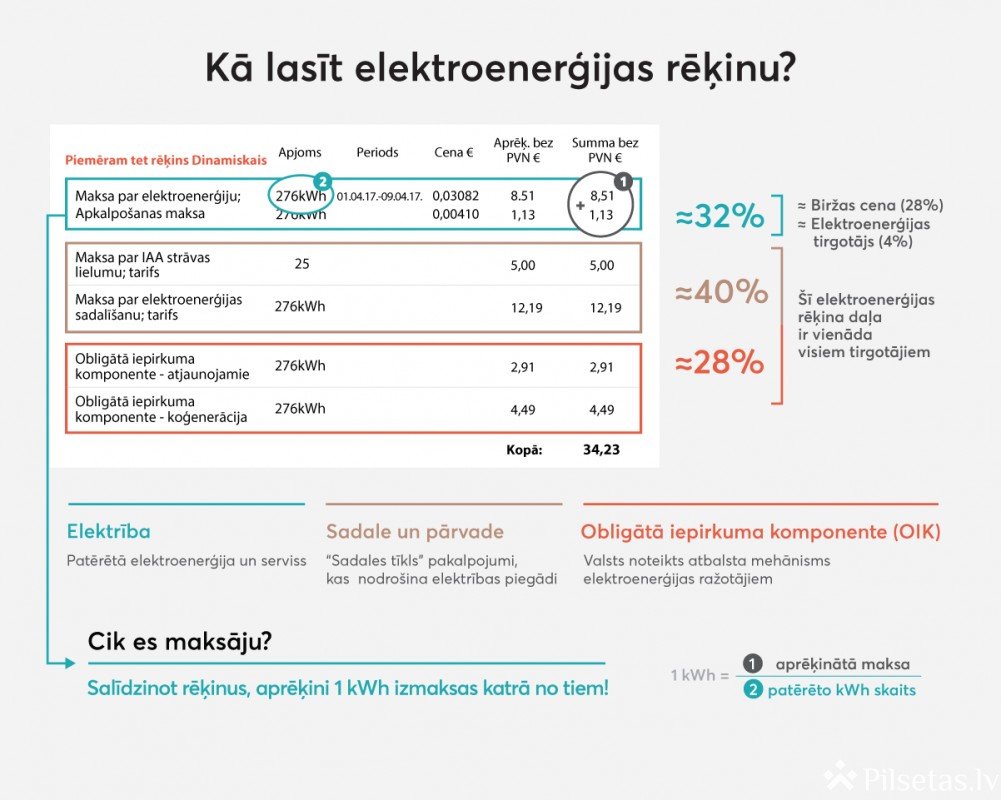
“Due to regulatory requirements, an electricity bill is genuinely complicated, as it includes not only payment for the electricity consumed by a household, but also other mandatory charges that will be identical regardless of the service provider—the distribution and transmission electricity supply charge and the state-mandated mandatory procurement component. For anyone who wants to understand and compare electricity costs among different service providers, the most important thing is to pay attention to the cost of one kilowatt-hour. This is the only way to determine the most advantageous offer, because electricity consumption changes every month,” explains Artūrs Pielēns-Pelēns, head of the tet electricity service at Lattelecom. He also answers the most frequently asked questions about electricity bills.
How much am I paying my electricity supplier?
It should be taken into account that the bill will fluctuate from month to month because of the amount of electricity consumed. For those who choose an equalised payment with a fixed monthly charge, the calculation for the actual amount of electricity consumed will be made at the end of the year or when changing electricity traders.
The simplest way to determine your electricity price is to calculate the price per 1 kilowatt-hour (kWh). To do this, add up all the amounts listed on the bill for electricity and divide the total by the number of kWh consumed. The names of the items may differ on bills from different service providers, but they most commonly include “electricity charge” and a “service charge” or “subscription charge”. This calculation does not include payments related to distribution and transmission services or the mandatory procurement component, as these will be the same for all service providers.
Whom am I paying?
The layout of information on a bill is determined by EU regulations and laws, and an electricity trader cannot vary its content. The bill of every electricity trader includes the OIK (mandatory procurement component), as well as the distribution and transmission charges. When the bill total is divided into percentages, approximately 28% consists of the OIK, around 40% is the distribution and transmission component, while the remaining 32% comprises the direct electricity consumption cost and the electricity trader’s charge—of this, approximately 28% is the cost of purchasing electricity on the exchange or from a wholesaler, and about 4% goes to the electricity trader.
How can I reduce the amount of my bill?
You can reduce the amount of your electricity bill by limiting electricity consumption and/or choosing an exchange-based tariff, such as tet Dinamiskais. Over the past 24 months, the exchange-based tariff was slightly higher than the fixed price in only one month; the fixed price is still used by most Latvian households. In addition, an exchange-based tariff allows energy to be used more intelligently—by slightly adjusting your habits and using more electricity at times when its price on the exchange is lower, you can save money. The process is also automated: electricity consumption is recorded automatically via a smart meter, and the price of electricity consumed is calculated every hour according to its price on the exchange at that particular time. AS Sadales tīkls installs smart meters free of charge for everyone who chooses a tariff plan linked to exchange prices.
* A survey of Latvian internet users conducted by the research company Norstat in January 2017.








