Latvian E-Index: The Level of E-Governance in Latvia’s Municipalities Improves
Over the year, municipalities’ e-governance development indicators increased by 34%. These indicators measure the range of digital solutions offered, the use of e-services among residents, as well as the use of technological capabilities in organising internal work, according to the Latvian E-Index assessment, which covers all 119 municipalities.
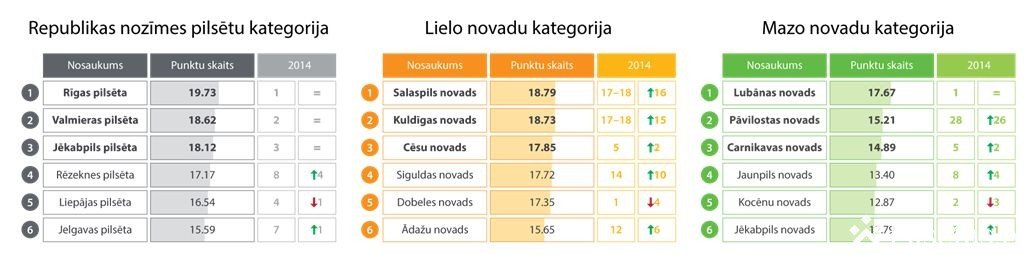
E-governance development has shown the sharpest increase compared with the other Latvian E-Index factors—development of e-environment infrastructure, the popularity of internet resources and people’s skills, and the security of information systems and data. While in 2014 municipalities received an average of 7.79 out of a possible 30 points for their e-governance indicators, last year these indicators reached 10.44. The highest results were recorded by the republican cities, followed by large municipalities and small municipalities.
“In 2015, Latvia surpassed the EU average in the use of public administration e-services. As the management of municipalities’ internal processes becomes increasingly digital, this promotes not only public participation and communication, but also improves the efficiency and productivity of municipal operations. This confirms that municipalities are becoming more open to technology and more resident-friendly. Technological development is ongoing, so the improvement of the digital environment must also be continuous,” explains Gusts Muzikants, head of the Latvian Municipalities E-Index working group and Lattelecom’s Commercial Director.
In every fifth municipal council, incoming and outgoing correspondence is organised entirely electronically in the central administration, while in every tenth, personnel records and internal orders are managed electronically. The number of municipalities that have introduced a document management system has also increased by 12%, thereby reducing costs, saving time in document-processing procedures and increasing efficiency.
The largest number of templates for forms related to services provided by the municipality, which facilitate and speed up communication with the municipality, is available on the websites of the Jūrmala City (155 forms), Salaspils (130), Rēzekne (99), Babīte (95) and Liepāja City (95) municipal councils. Meanwhile, only five municipalities no longer have any form templates posted on their websites, compared with 14 previously.
Residents are increasingly choosing to register their place of residence electronically—the indicator has increased by 10%. In certain municipalities, particularly large and small municipalities, a particularly high proportion of residents choose this e-service, including in the municipalities of Aizpute, Ērgļi, Rauna and Nereta.
E-governance development was determined by taking into account both the range of digital solutions offered by the municipality (the level of digitalisation of municipal services, and form templates and service descriptions on the municipal website), the use of e-services among residents (registration of place of residence and issuing of real estate tax bills), as well as the use of technological capabilities in organising municipal work (a document management system and its application, internal document management, etc.).