
Liepāja turns 394! Do you know your city's history?
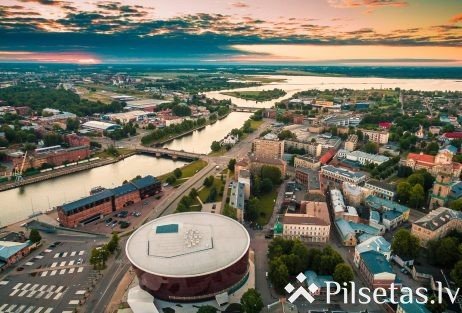
Today is Liepāja's 394th birthday. The city's charter was granted to Liepāja on 18 March 1625 by Duke Friedrich Kettler of Courland.
The city's origins date back to the 13th century, when the village of Līva was established between the lake and the sea, where the Līva River flowed. The name of the village of Līva was first recorded in written sources on 4 April 1253.
Liepāja experienced its economic boom during the 17th century, when important works were carried out – the most significant of them being the construction of the port, which began on 3 October 1697 with the driving of the first pile. Liepāja grew from a small village of approximately one thousand inhabitants into a small port city.
This was followed by major trials – an exceptionally large fire and an outbreak of the plague. The greatest tragedy occurred in November 1698, when the city was destroyed by an unprecedentedly large and powerful fire.
At the end of the 18th century, the city flourished once again as port operations expanded and trade and crafts developed.
In the 19th century, Liepāja grew from an insignificant provincial town into an industrially developed centre. Industry expanded with the construction of the Liepāja–Romny railway line. This was the period when the foundations were laid for the traditions of the metalworking sector.
The improvement and expansion of Liepāja's port in the 1870s–1880s also promoted industrial growth in the city. Metalworking came first, represented by the three largest companies in this sector in Courland: “Bekers un Ko”, “Vezuvs” and “Folga”. Approximately 50% of the city's workers were employed by them.
In 1899, Liepāja became the first city in the Baltics to introduce an electric tram, which remains an important means of transport in the city.
Because of its port, developed industry and access routes, Liepāja occupied an important place in Russia's military-strategic calculations and was selected as a base for the Russian Baltic Fleet. In spring 1899, the project for the construction of Liepāja Naval Fortress was approved, and during the following decade a naval port was built, with land fortifications surrounding the city to protect the military base in the event of an enemy attack.
Less than 10 years after its construction – in November 1908 – the Liepāja fortress was decommissioned. To destroy the fortifications, they were blown up twice. Artillery batteries that were not completely demolished, underground structures and powder magazines have survived to this day.
At the beginning of the 20th century, industry and transit trade became the pillars of the city's economic life, while the textile industry was also well developed. Liepāja became the largest emigration centre in Russia, aided by direct ship connections with New York. During this period, approximately 50–70 thousand people travelled through Liepāja.
The First World War followed, beginning in Latvia on 2 August 1914 with the shelling of Liepāja's port. In May 1915, Liepāja was occupied by ground forces. By the end of the year, only 43 600 inhabitants remained in the city. At that time, Liepāja was under German occupation, suffering shortages and economic decline.
In 1918, Latvia proclaimed independence. In 1919, Liepāja became Latvia's capital for half a year, when, following the coup by the German army, the Latvian Provisional Government took refuge in Liepāja's port aboard the steamship “Saratov”.
After the war, the city's economy had suffered, but it gradually began to recover and stabilise. At the same time, cultural and artistic life flourished – Latvia's first children's art school was opened, an opera was founded, the existing theatre was strengthened, and a conservatory and philharmonic were established. Several new schools were also opened in the city. The population reached 67 thousand. In addition, regular air services connected Liepāja with Riga from 1937 to 1939.
This was followed by the difficult years of occupation and deportations. Fifteen thousand Soviet soldiers were stationed in Liepāja, an uncontrolled influx of Soviet military personnel into the city began, and civilians' freedom of movement was restricted.
Then came the tragic days of 1941 and 1944, when part of Liepāja's most beautiful central architecture was destined to be reduced to ruins. The city was bombed. After the Second World War, Liepāja's centre was severely devastated, and many historic and significant city buildings were reduced to rubble; consequently, the city today has no clearly defined Old Town.
After the war, the city was subordinated to the plans of the Soviet Union. New residential districts and industrial complexes were built to fulfil national economic plans. During the Soviet period, Karosta became a closed military territory inaccessible to Liepāja's civilians.
During this period, the population, including military personnel brought in from elsewhere, exceeded 100 thousand.
Following the decision adopted in 1990 to restore independence, demonstrations and strikes took place. It was only on 31 August 1994 that the former Soviet naval base in Liepāja ceased to exist entirely, and the last Soviet army soldiers left Liepāja.
Over the next twenty years, the city was gradually cleared of the dangerous legacy left by the Soviet army – buildings were put in order, infrastructure was restored, and previously closed territories were made accessible.
Today, Liepāja is the third-largest city in Latvia and the tenth-largest city in the Baltic states, chosen as a home and a place to work and study by approximately 70 000 people. Liepāja is a popular tourist destination, attracting visitors with the unique sights of the former military territory of Karosta, enchanting them with a city centre rich in cultural and architectural gems, and captivating them with its broad beach, where the unusually white, fine sand creates a special experience.
Sources: liepaja.lv, vietas.lv








