Searching for Employment Records and Family Genealogy
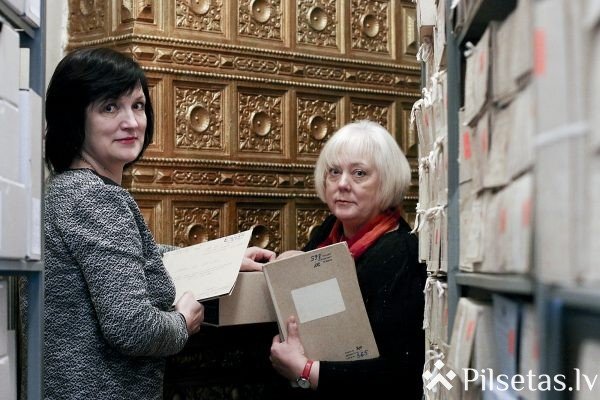
Among the centenarians celebrating a milestone anniversary this year is the Latvian National Archives, while its structural unit, the Cēsis Zonal Archives, will mark its 55th anniversary in October.
If anyone thinks that the Cēsis Archives holds documents related to the processes involved in the founding of the state in our region, they will be disappointed, because, according to senior expert Anda Opoļska, Latvia has preserved an inexplicable chronological division: “The Cēsis Archives holds documents from October 1944, that is, from the time when the German troops left and the Soviet Army arrived. There are no documents from before that, because, in accordance with the requirements, documents bearing witness to the bourgeois period could not be kept here. All documents dating up to 1944 were transferred to the Historical Archives, although in fact all documents starting from the founding of the Latvian state should be here.”
However, this 55-year history is also in demand: people visit the archives to obtain certificates supplementing their employment records, search for documents concerning property ownership, and inquire about their family genealogy.
Lelde Meidropa, director of the Cēsis Zonal Archives, says that changes in the law, particularly those concerning pensions, have a noticeable effect on the flow of visitors: “When the legal provision concerning employment records was recently changed, people came looking for documents about their work in collective farms and Soviet state farms, so that they could reach 30 years of employment, which guarantees a higher pension. Some were short by very little— a month, a few weeks, or even just a few days. When people receive the certificate they need, they appreciate how important the archives are. But there are also negative experiences, when the required document is not available and we have to hear reproaches that we are to blame. Yet documents do not come to the archives by themselves; someone has to organize them and hand them over to us for safekeeping,” explains L. Meidropa.
There was an interesting case involving a man who came looking for the documents of a limited liability company in order to prove his employment record. When it was established at the archives that the documents were not there, the employees suggested that he look for the company’s owner. The man then admitted that he himself was the owner, but had no idea what had happened to the documents.
A. Opoļska explains that companies themselves can choose whether to keep their documents or hand them over to the state for safekeeping. However, a company cannot be removed from the Register of Enterprises until the issue of document storage has been settled. The archives acknowledge, though, that there are quite a few gaps, particularly concerning the beginning of the 1990s; sometimes even the final Soviet years have disappeared into oblivion, when, as systems changed, the organization of documents was neglected.
Service in the armed forces, including the Soviet Army, is also counted toward an employment record, but military service books are required for this. A. Opoļska recalls a historical event from the period of the National Awakening: “At an event in Cēsis, men publicly threw their military service books into a symbolic urn to be burned. We can offer the reassuring news that they did not disappear, because someone unknown brought them to our archives. This is a positive experience, but there is also a negative one: we are the only archives in Latvia that does not hold the conscript card index, which recorded military service book numbers. At one time, some diligent employees destroyed this card index, thinking that no one would ever need anything like it.”
Last year, more than 500 consultations concerning certificates related to employment records and education were registered at the Cēsis Zonal Archives. Legal entities are also provided with consultations on organizing documents, while people come to inquire about researching documents for personal needs, learning, and studies.
People living and working in other countries also inquire about the documents they need. For example, someone studied at the Jāņmuiža Vocational Secondary School and needs a certificate confirming that they obtained a specific qualification. Information has also been requested about studies at a nursing school; unfortunately, it is incomplete, apparently because the people working at the school did not consider it important to fill in all the documents and fields.
The director points out that people who live in Cēsis but worked or studied elsewhere do not have to travel anywhere to obtain the certificate they need. They can come to the Cēsis Archives, submit a request, and receive a reply here after some time. To make the archives even more accessible, a new customer service centre will open in the spring, with an entrance from 3 Lenču Street. The premises once housed the “Fotolukss” shop, then an LMT customer service centre, and in recent years the “Taipans” security company.
“When the premises became vacant, we began thinking that they could be useful to us,” says L. Meidropa. “Like the entire archives building, they belong to the state-owned real estate company. The matter was resolved favourably, and we plan to open a customer service centre in the spring. The main idea is to ensure accessibility, which is completely impossible to provide in the existing premises. With this step, we will be even more accessible to people.”
The director adds that the long-held dream of constructing a new archives building has not been abandoned either. It has also been included in the planning documents.