
Psychologist: “Playing with children is just as important as saying ‘I love you’”
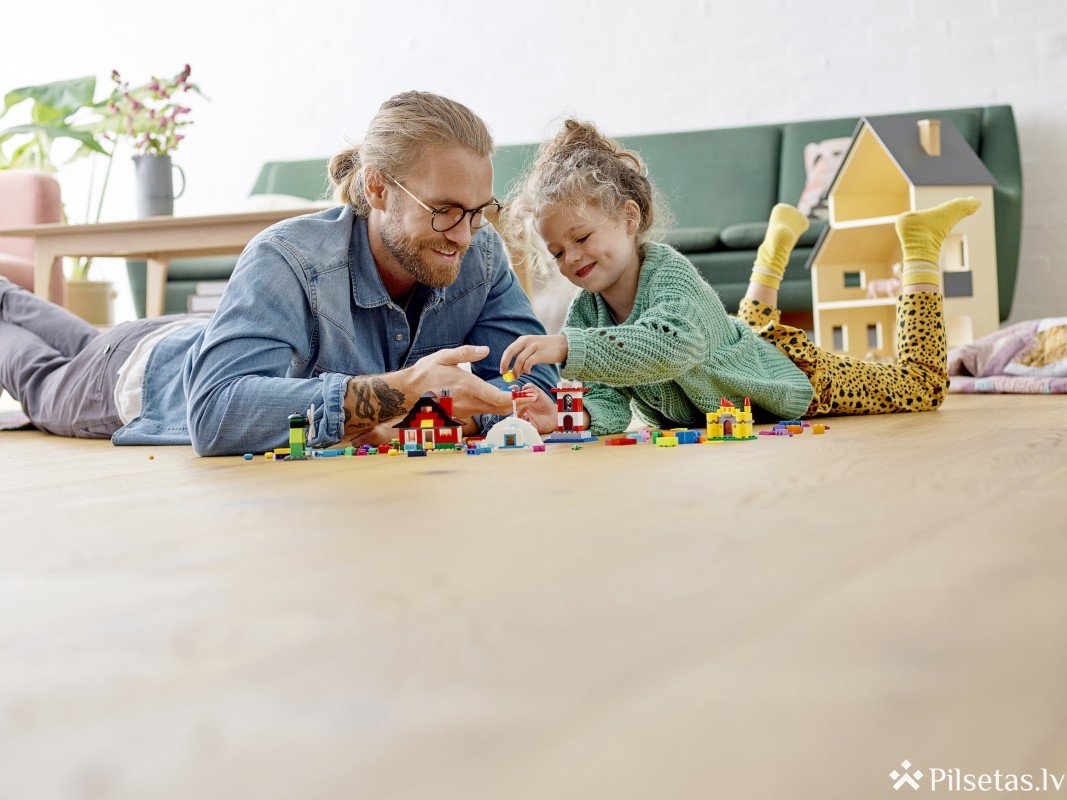
Families that play together undisturbed for at least five hours a week are happier than families that devote less time to it. However, a study conducted by toy manufacturer LEGO shows that 61% of parents turn to smart devices or other household chores while playing together, unable to devote quality time to their children. Psychologist and psychotherapist Līga Bernāte explains why playing together is important not only for children but also for parents.
Play is an important process not only for entertaining children but also for their development and education. The LEGO study reveals that 83% of children acquire new skills and knowledge most effectively through play, while 95% of the parents surveyed would like play as a learning method to be integrated more widely into school curricula. Likewise, the majority (86%) of children and parents acknowledge that playing together helps them relax after the stress accumulated during the day. Unfortunately, more than half (61%) of parents admit that they are unable to devote quality time to their children and turn away to answer emails, check social media updates, clean the house or prepare meals.
As psychologist and psychotherapist Līga Bernāte points out, the rush of modern life sweeps families into a whirlwind, and seemingly very simple things that are necessary for a child’s successful development are forgotten and undervalued: “A child’s successful development requires a close connection with parents and play. For the human brain to mature, it needs another person with whom to be in contact, and it needs play. Playing involves the use of all the senses – even when playing with the most ordinary toy, a child uses sight, touch, their body and hearing. If they think about what to do with it and how to use it, thinking, memory and attention are engaged. The child also experiences emotions—joy, disappointment, achievement and anger. When a parent joins in the play, communication must begin—the child has to learn to converse, share, wait their turn and seek compromises. These are the foundations of good communication skills, which nowadays are often valued even more highly than academic knowledge. If a child is able to engage their imagination while playing, creativity and the ability to fantasise also develop, and these are necessary for the development of logical thinking.”
Bernāte emphasises that when parents play together with their children, irreplaceable bonds are created within the family: “When playing together, parents have the opportunity to follow the child’s lead and get to know them in a very different way than by talking about everyday matters or giving instructions. It also helps the child feel valued and appreciated, because they genuinely experience the relationship and the parent confirms their words through actions. For example, ‘You are important to me’ are difficult words to prove if I cannot find time to do together with you what matters to you and brings you joy. It is similar to saying ‘I love you’ while not looking the child or another person in the eyes, hugging them or stroking them. Children’s language is playing, and if we want to ask something of them, we must provide plenty of support and love. One of the best ways to do this is to play together with them.”
To see the impact of one hour of uninterrupted play on a family, LEGO invited the Kalniņš–Ūselis family from Riga, who are raising two sons, to take part in an experiment and devote an hour of their day off solely to spending time with their children, without using smart devices or switching to other tasks. After the experiment, the family acknowledged that during this hour the children shared things they might not have shared in another situation: “Perhaps at another time we would have been doing household chores in parallel, but it was very good for all four of us to spend time together in a completely different rhythm and in peace. Our main realisation is that it is not so difficult to find time to spend together without interruptions; the main thing is to remember to do it from time to time, because it is very easy to forget in the rush of everyday life. As parents, playing together also gives us fewer pangs of conscience about not devoting enough time to the children.”
The full video of the experiment can be viewed here – https://www.youtube.com/watch?v=8U9rnaJYF7s








