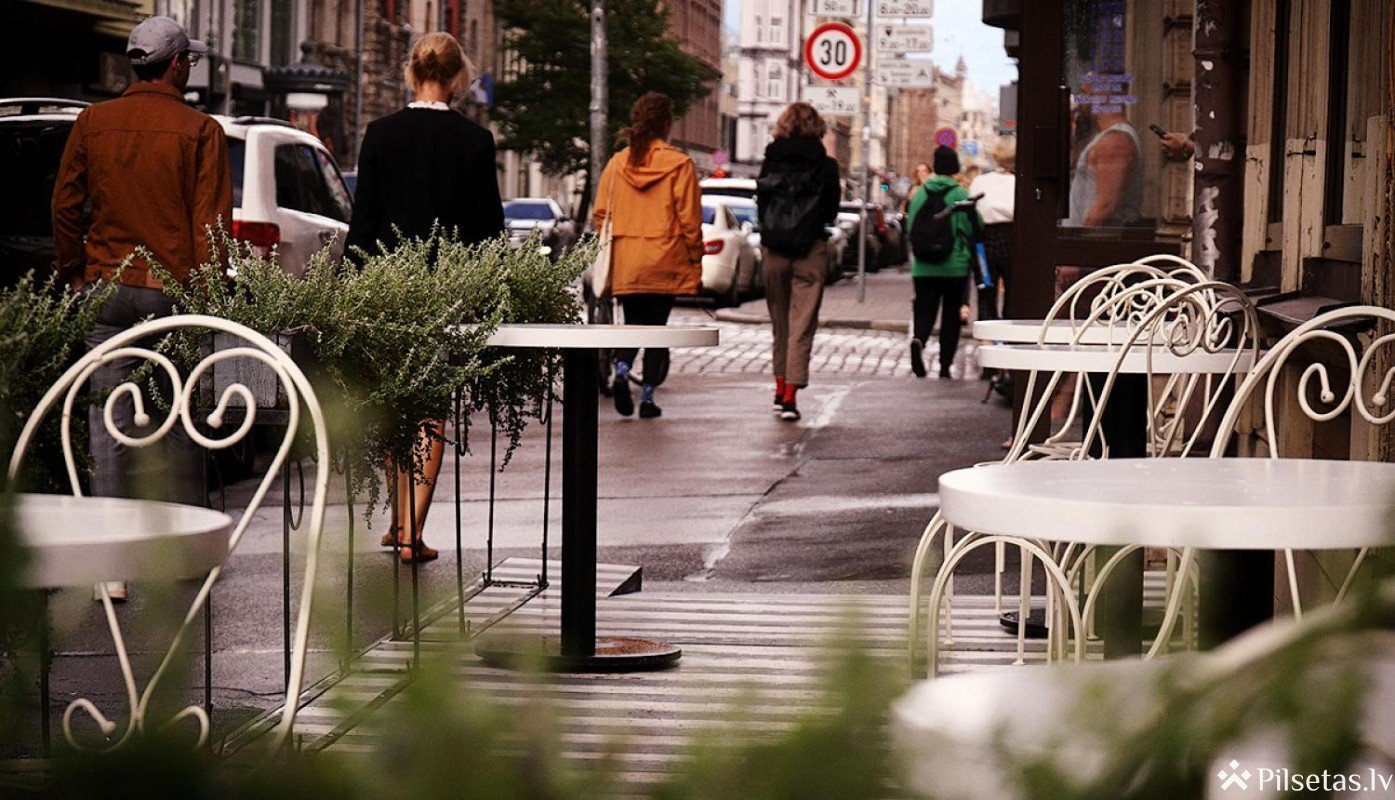
On Wednesday, 31 March, the Riga City Council adopted new street-trading regulations aimed at supporting businesses and mitigating the effects of the COVID-19 crisis by substantially simplifying the approval of street-trading sites and summer terraces, while also reducing the number of procedures required for approval.To promote business activity, it will be permitted to install a counter in an approved summer terrace for serving food and processing payments. The counter’s design must be integrated into the design of the summer terrace (this change will apply temporarily, for as long as regulations are in force in the country allowing food-service establishments to provide food only for takeaway).
Under the existing regulations, street-trading sites providing food-service activities were permitted to sell food products only for consumption at the point of sale. Therefore, amendments were prepared allowing outdoor terraces to be used for serving food to customers for takeaway; menu boards will also be permitted.
Compared with the existing procedure, the new regulations introduce several significant changes. Permanent street trading will be renamed registered street trading, and in future, provided that the location and visual design of the trading site are not changed, approval from the Riga City Construction Board will be valid for three years.
Once the approval period has expired, if a trader wishes to install the same street-trading site design at the particular location, a new project will no longer need to be submitted to the Construction Board. Similarly, a street-trading project will no longer need to be submitted if the trading site is set up in accordance with a standard design specified by the Construction Board (the sketches will be available on the Construction Board’s website).
Significant changes are also envisaged in the procedure for installing summer terraces. In future, the Riga City Construction Board will have the right to waive the height requirements for elements enclosing a terrace if the solution proposed by the business is transparent, aesthetically pleasing and does not alter the visual perception of historically and culturally valuable buildings. Approval from the Construction Board and the Riga City Council’s Transport Department will likewise no longer be required if the street-trading site is set up in accordance with the specified standard design for a summer terrace.
The deadline for dismantling an unused summer terrace has also been extended. Once the planned regulations are approved, businesses will be permitted not to dismantle a terrace until 31 March 2023.
It is also planned to permit trading from mobile bar kitchens located outside the terrace area on the carriageway and occupying part of a parking space, with sales conducted from an equipped motor vehicle or trailer.
The new regulations also include additions concerning personal-data protection and compliance with safety measures. The content of the documents to be submitted to the Riga City Construction Board and the permitted range of goods have been editorially clarified, and the rights obtained in the 2019 competition to organise street trading during the Christmas period in Esplanade and Dome Square have been extended by one year. The necessary amendments have also been made in connection with the establishment of the Riga City Neighbourhood Residents’ Centre, the reorganisation of the Riga City Council’s Visitor Reception Centre and the liquidation of the Riga City Municipality’s executive directorates.
The new regulations will replace the existing Riga City Council binding regulations No. 198, “On the procedure for approving and organising street trading”. The amendments concerning the sale of food on terraces will enter into force after publication in the official gazette Latvijas Vēstnesis, while the remaining regulations still need to be coordinated with the Ministry of Environmental Protection and Regional Development.
Information prepared by:
Public Relations Project Manager of the Riga City Construction Board