Rye or wheat after all? Latvia’s residents have mediocre knowledge of cereals
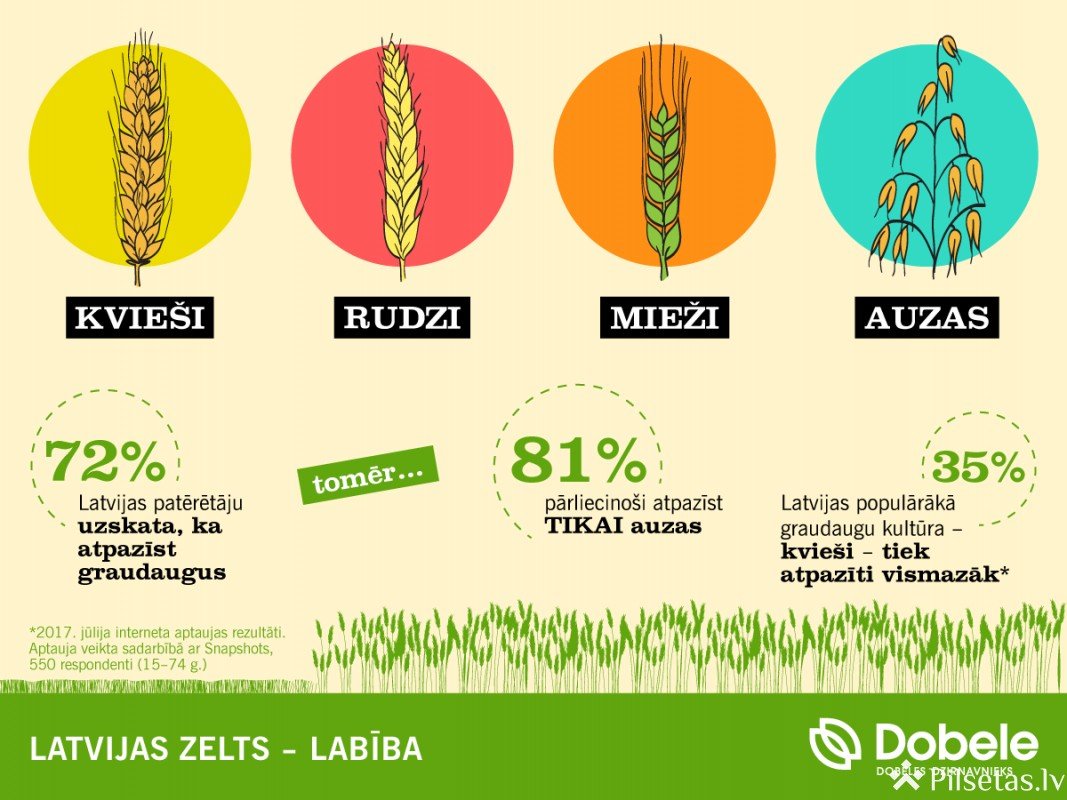
Seven out of 10 Latvian residents claim that they can recognise the most popular cereals—oats, rye, wheat and barley—yet in practice their knowledge falls slightly short of their self-assessment, according to a survey conducted by “Dobeles dzirnavnieks”. Rye is most often confused with wheat, while oats are recognised best.
Oats are the easiest to recognise visually
When their knowledge was tested in practice, oats produced the most convincing result: 8 out of 10 respondents correctly recognised them in a picture. By contrast, the ears of rye and barley were visually recognised by half as many residents—just 4 out of 10—while wheat was identified by only one-third. This is most likely because oats differ from the classic form of cereal: they have a panicle rather than an ear.
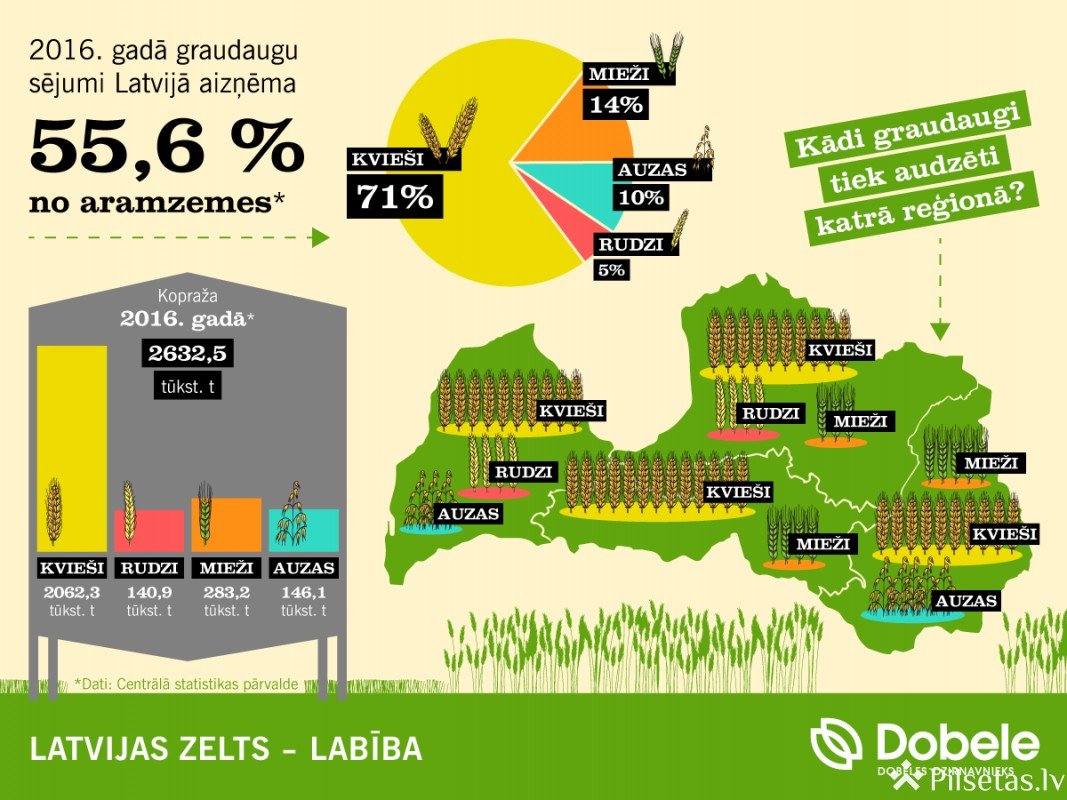
“Latvia has neither oil nor gas in significant quantities, but it does have fertile land. Cereal crops occupy slightly more than half of Latvia’s arable land, and the active harvest season is due to begin very soon. Zemgale, which is rightly called Latvia’s breadbasket, will be especially busy. I encourage people to use this opportunity to go out into the countryside with their families or friends and appreciate Latvia’s ‘gold’—its crops—in person. Turn the harvest season into a wonderful educational activity, revisiting or discovering anew what valuable things grow in our own land,” advises Kristaps Amsils, Chairman of the Board of AS “Dobeles dzirnavnieks”. He also reveals that wheat is harvested in the greatest quantities in Latvia, followed by barley, oats and rye.
It turns out that young people aged 15 to 24, as well as residents over 55, have the best skills when it comes to recognising different cereals.
Self-assessment higher than actual knowledge
Slightly more than 25% of Latvia’s residents are confident in their knowledge and claim that they can recognise different types of crops very well. However, in practice even these respondents had difficulty identifying wheat, barley and rye.
Forty-five per cent of those surveyed are more cautious, indicating that they can recognise cereals only partially, while 29% of Latvia’s residents admit that they cannot distinguish between different cereals at all. This is also demonstrated by the practical task, in which this group achieved significantly lower results.
Residents of rural regions rate their knowledge more highly: nearly half say that they recognise cereals well, which is also confirmed in practice. By comparison, only 18% of those surveyed in Riga consider themselves experts. Interestingly, men’s self-assessment of their knowledge is higher than women’s: 34% of men consider themselves experts, compared with only 20% of women.
Couscous and bulgur—still not fully familiar
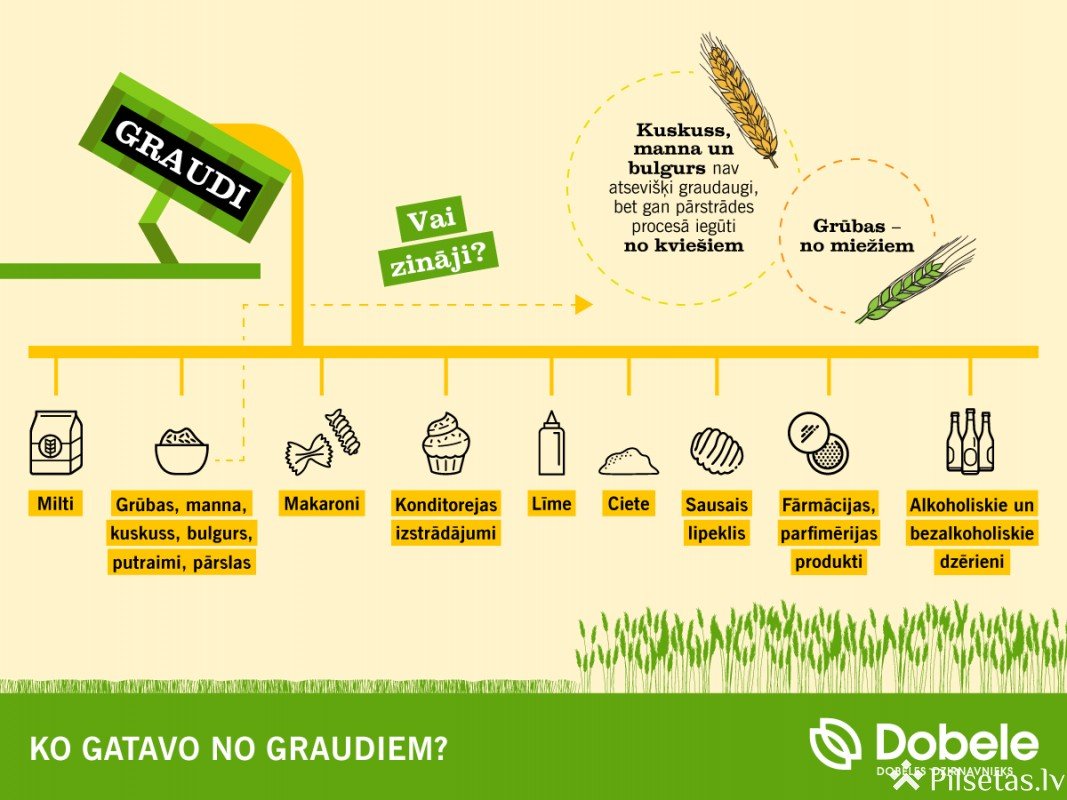
When asked what various cereal products—such as semolina, pearl barley, couscous and bulgur—are made from, residents were most knowledgeable about traditional semolina: 62% correctly indicated that it is made from wheat. Meanwhile, only half of those surveyed know that pearl barley is actually polished barley grain.
Couscous, which consists of small wheat-flour granules, and bulgur, which is made from cracked wheat—both of which have become known in Latvia only relatively recently—are still fairly unfamiliar. Both are predominantly made from hard, or durum, wheat. Accordingly, only 29% of residents know that couscous is a wheat product, while 21% know that bulgur is also made from wheat grain.
About the survey
The survey was conducted in cooperation with Snapshots. It involved 550 respondents aged 15 to 74. The survey was conducted online in July 2017.
About AS “Dobeles dzirnavnieks”
AS “Dobeles dzirnavnieks” is Latvia’s largest grain-processing company. Its main areas of activity are the production of all types of wheat flour, semolina, flour blends, pasta, cereal flakes, groats and animal feed. More information is available at www.dzirnavnieks.lv.