
Seminar Examines the Adult Education System and Support in the Republic of Korea
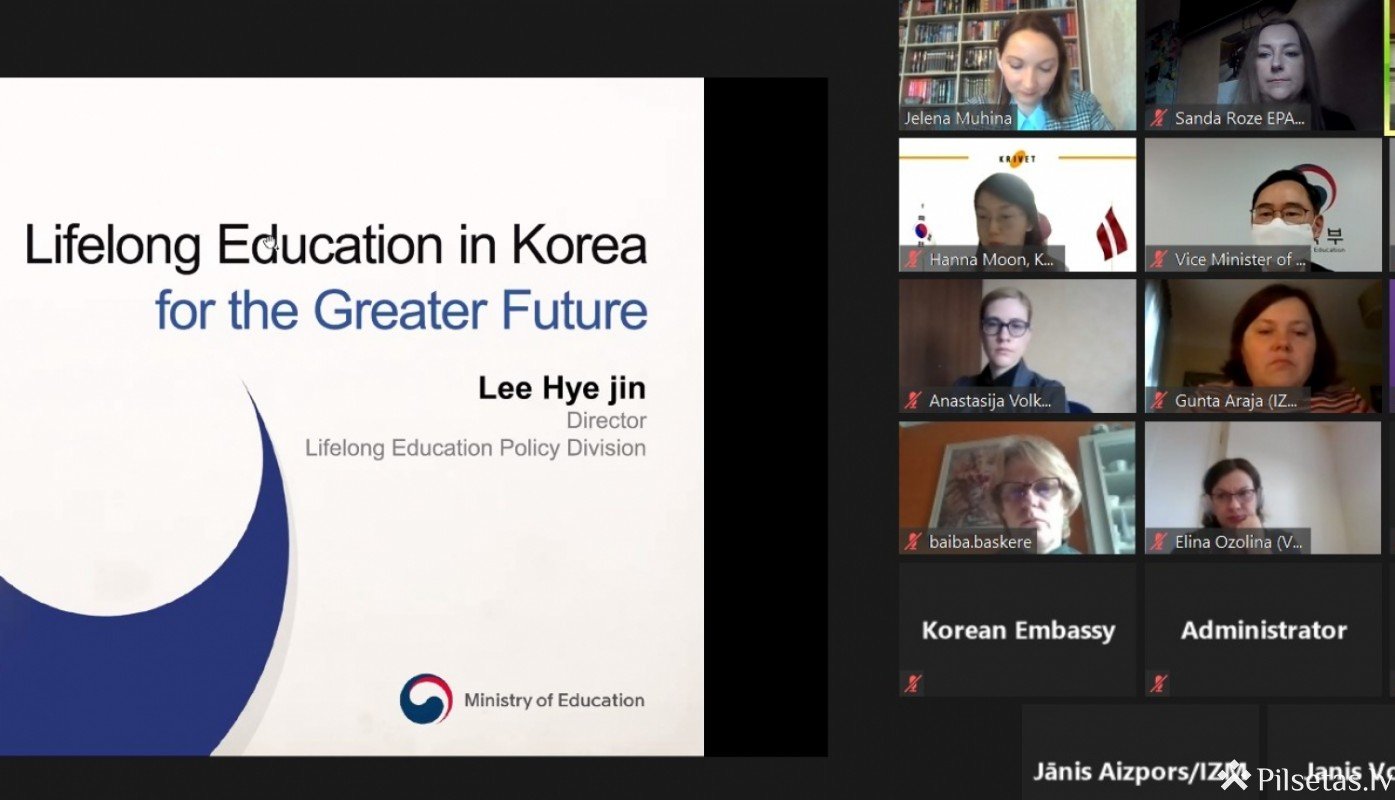
On Friday, 7 May 2021, representatives of the Ministry of Education and Science (MoES) held a remote meeting with representatives of the Ministry of Education of the Republic of Korea and the Korea Research Institute for Vocational Education and Training to learn about the country’s human resources development policy, which has resulted in significant economic progress in the country over several decades. The seminar was organised in cooperation with the Embassy of the Republic of Korea in Latvia.
According to data from the OECD Programme for International Student Assessment (PISA), South Korea’s education system ranks among the best in the world, with its performance significantly higher than the OECD averages. South Korea ranks seventh in mathematics, ninth in reading literacy and fourth in problem-solving in PISA.
The interinstitutional online seminar was opened by MoES Parliamentary Secretary R. Znotiņš and Deputy Minister of Education of the Republic of Korea Jong Chul Jung, after which participants were introduced to Korea’s lifelong learning policy and principles.
Korea’s lifelong learning system is divided into two pillars. The first pillar is administered by the Ministry of Education and focuses on leisure learning—also referred to as “civic” or “life-enrichment” learning—that is, courses not directly related to employment, such as calligraphy and languages. Its legal framework is the Lifelong Education Act (1999). The second pillar is based on the Labour Standards Act and is administered by the Ministry of Employment and Labour. This pillar focuses on skills important for employment. These courses are provided, for example, by polytechnics and universities. Free MOOC courses (K-MOOC) prepared by universities are also available to anyone interested.
As the MoES plans to develop and pilot an individual learning account approach to improving digital skills, particular attention was paid to one of Korea’s forms of lifelong learning support—the Lifelong Learning Card. This is an individual lifelong learning voucher that can be applied for by any employee covered by employment insurance, as well as by unemployed people, employees whose contracts are soon to expire and temporary workers. Applications for the cards are submitted at local employment centres. Approximately 480,000 cards were issued in 2018 and 541,000 in 2019.
The Republic of Latvia and the Republic of Korea have concluded an Agreement between the Government of the Republic of Latvia and the Government of the Republic of Korea on cooperation in culture, education, youth affairs and sport, which was signed in Riga on 19 October 2011.
Author:
izm.gov.lv








