Ancient Lifestyle School “Bone in Renaissance Art and Everyday Life”
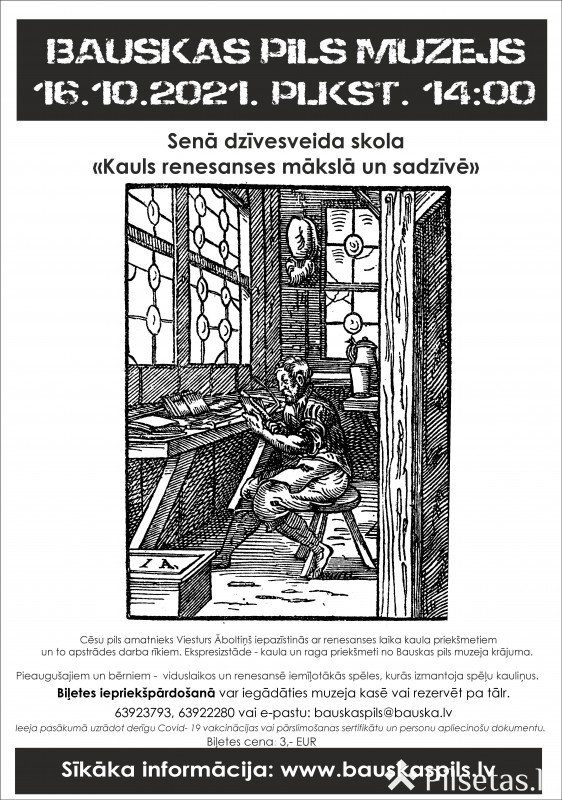
On Saturday, 16 October at 2:00 p.m., Bauska Castle will welcome Cēsis Castle craftsman Viesturs Āboltiņš, who specialises in the study of archaeological artefacts made of bone and horn and in producing replicas using ancient methods. The master craftsman will introduce visitors to bone objects from the Renaissance period and the tools used to process them.
During the event, castle visitors will have the unique opportunity to view original bone and horn objects from the Bauska Castle Museum collection in a special exhibition and to hear the master craftsman’s comments on the displayed artefacts. V. Āboltiņš will lead a workshop in which those interested will be able to make spinning tops and simple gaming dice. Meanwhile, museum specialists will teach event visitors—adults and children— games popular in the Middle Ages and the Renaissance that used bone gaming pieces.
The interiors of Bauska Castle also feature objects characteristic of the furnishings of Renaissance-period castles, which can be viewed independently: a table and cabinet decorated with ivory inlays, as well as an ornate chandelier decorated with fallow deer antlers. The museum collection contains fragments of bone and horn objects found during archaeological excavations, demonstrating that in the 16th and 17th centuries the castle’s inhabitants used various bone objects in everyday life. Archaeologists found larger quantities of tableware handles, beads, and fragments of decorative firearm parts—engraved deer-antler plates.
Objects made of an exotic material—ivory—deserve special attention. During the periods of Livonia and the Duchy of Courland, merchants brought such objects through the Port of Riga from the Netherlands’ largest ivory-processing centres. Ivory was used not only in the furniture industry—for ornamenting tabletops and decorating cabinets and chests—but also to produce the double-sided combs needed in everyday life, as they lasted longer than combs made of horn or wood. In the Middle Ages and the Renaissance, board games were popular forms of recreation and entertainment—chess, draughts, backgammon, and various dice games using carved or turned bone dice or playing pieces.
Illustrations in books about ancient crafts depict, among others, artisans who specialised in making particular bone and horn objects: rosary-bead makers, comb and lantern makers, firearm-stock decorators, and knife-handle carvers.
What were the secrets of masterful bone processing? Who were the “three companions from Basel”? Why were dice made of bone considered the best for achieving good luck in games? You will learn the answers to these and other mysteries at the event.
Admission to the event is available upon presentation of a valid vaccination or COVID-19 recovery certificate and an identity document (passport or ID card). FFP2 respirators must be worn during the event.
Tickets can be purchased at the Bauska Castle Museum ticket office and reserved by calling 63923793 or 63922280, or by email: bauskaspils@bauska.lv. Reserved tickets must be collected no later than 30 minutes before the event.
Ticket price: EUR 3
Information prepared by:
Head of Public Relations and Customer Service at the Bauska Castle Museum