The Dripping Unconscious: The Surrealism of Pēteris Kārkliņš
On Saturday, 22 November, at 4:00 p.m., an exhibition of works by Pēteris Kārkliņš will open at the Sīpoliņš Gallery of the World Latvian Art Centre. The exhibition will be on view until 22 June 2026.
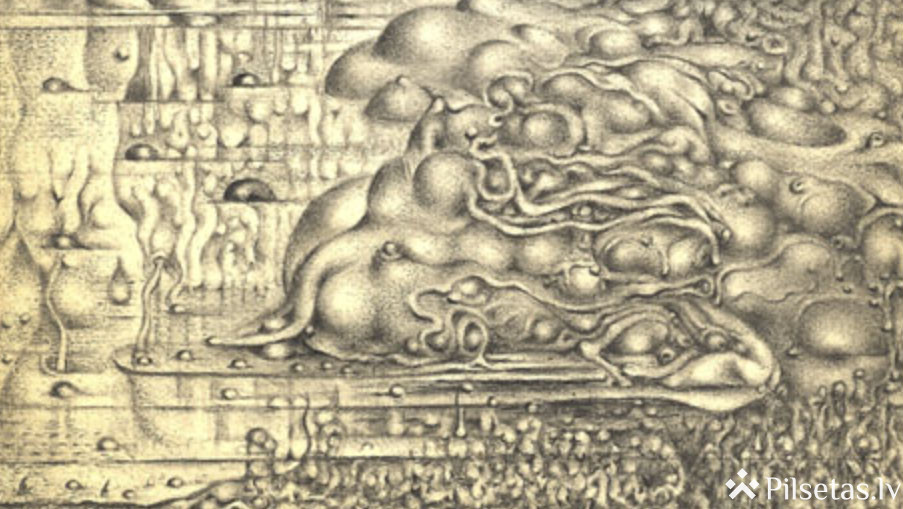
Pēteris Kārkliņš’s small, hermetic drawings capture disturbing processes taking place directly beneath the surface of human life. The complexity of his organic forms corresponds to the artist’s meticulous system of notation: on the back of each sheet, he carefully records the time and circumstances in which the work was created. These visceral images seem not only fluid and flowing, but at times frightening as well; together with the sparse, laconic notes on dates and places, they form an intense, concentrated meditation on the passage of time and the processes of mortality.
Pēteris Kārkliņš was born in East Germany in 1945. In 1951, his family emigrated to Chicago, where he studied printmaking and sculpture. For several years, he worked as an architectural model maker, but when computer modelling replaced the profession, he became a security guard at various locations in Chicago. The drawings presented in this exhibition were created on trains while travelling to and from work, as well as at his desk during night shifts.
Some Latvian diaspora artists turned to nostalgia and a sense of loss in their work, while others sought to embrace the avant-garde movements of their time. Kārkliņš’s works, however, are so unique and distinctive that they exist outside any historical narratives on any continent. Partly following in the footsteps of Max Ernst and Salvador Dalí, while simultaneously exploring our unconscious and the unfathomable natural world that civilisation seeks to keep at a distance, Kārkliņš has created his own unique, one-person art movement. It is characterised by a strange, unsettling visual language, an unusual creative process, and a new system of values through which he defines his own frightening conception of beauty.
Kārkliņš has exhibited at several leading galleries in America, and his work has been written about by many of the leading Jungian philosophers of our time.
This will be the first time his works are exhibited in Latvia.