
The overgrowth of rivers and other bodies of water contributes to the loss of aquatic life and the destruction of coastlines
Over the past 100 years, the unique ecosystem of the Baltic Sea has become a nutrient-saturated, eutrophic environment, and eutrophication is a major problem in Latvia’s rivers, lakes and sea. Therefore, the mineral water brand “Mangaļi”, in cooperation with the World Wide Fund for Nature במסגרת the “For Clean Rivers!” project, calls on residents to pay attention to their everyday habits that contribute to the overgrowth and degradation of bodies of water. Failure to care for the condition of rivers and other bodies of water poses a threat to the fishing industry; fish and other aquatic organisms cannot live properly, and it may also mean that in the future people will no longer want to spend time on beaches because bodies of water will have become overgrown.
Eutrophication is a process caused by excessive amounts of nutrients entering the water, resulting in excessive algal growth, the degradation of aquatic ecosystems and overgrowth. Eutrophic bodies of water contain vast expanses of flowering cyanobacteria, which not only reduce water transparency but also consume the oxygen in the water, leading to mass fish deaths and harming the health of swimmers. The only way to reduce eutrophication is to reduce pollution levels.
“As the amount of nitrogen and phosphorus in the water increases, algae multiply, die and decompose. The water becomes cloudy, and sunlight can no longer reach the plants that provide oxygen. In agriculture, plants are nourished with fertiliser, but if there is too much fertiliser, plants cannot absorb it all. Unabsorbed nutrients enter lakes and rivers through the soil, and all rivers flow into the sea. Nitrogen that contributes to eutrophication also enters the water from the atmosphere, where it accumulates from smoke-belching chimneys, as well as through wastewater and the cleaning products we use at home. Eutrophication affects 97% of the Baltic Sea, while 27% of the seabed is oxygen-free and therefore dead,” explains Magda Jentgena, Head of the Baltic Sea and Freshwater Programme at the World Wide Fund for Nature.
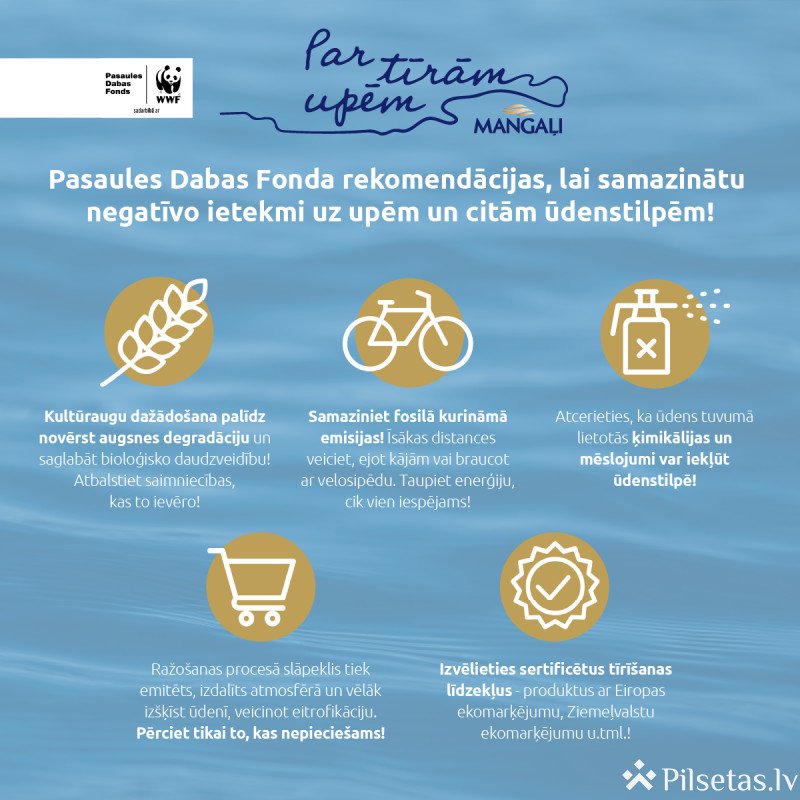
The World Wide Fund for Nature has compiled several recommendations that everyone can implement in their everyday lives to reduce their negative impact on rivers and other bodies of water.
- Choose products from small and local farms!
- Crop diversification helps prevent soil degradation and preserve biodiversity. Support farms that follow this good practice.
- Choose certified cleaning products! The EU Ecolabel, the Nordic Swan Ecolabel, the Blue Angel (Germany’s ecolabel) and Good Environmental Choice are some of the labels that are preferable in order to prevent bodies of water from being harmed by the use of cleaning products.
- Take care to ensure that untreated household wastewater does not enter groundwater, ditches, rivers, lakes or even the sea. This will benefit not only your well-being but also that of many aquatic species.
- Always be mindful of what you do near water. Chemicals and fertilisers used near water can enter a body of water and severely worsen its ecological quality.
- Buy only what you need! During the production process, nitrogen is emitted, released into the atmosphere and later dissolves in water, contributing to eutrophication. This applies to food as well as other goods.
- Reduce fossil fuel emissions! Travel shorter distances without using a car—walk or cycle instead. Save as much energy as possible. Choose renewable energy.
“Rivers are an essential link in the health of the ecosystem as a whole. Realising how critical the situation concerning the aquatic environment is, we feel an even greater responsibility and motivation to care for the free flow of rivers. We call on everyone to monitor their everyday habits so that together we can all live in a clean and natural environment, without reaching a situation where we have to wonder whether it is safe to spend time near a particular body of water,” says Ilze Auziņa-Grabeca, Marketing Manager at SIA ‘’Cido Grupa’’.
More about the “For Clean Rivers!” project: https://partiramupem.lv








